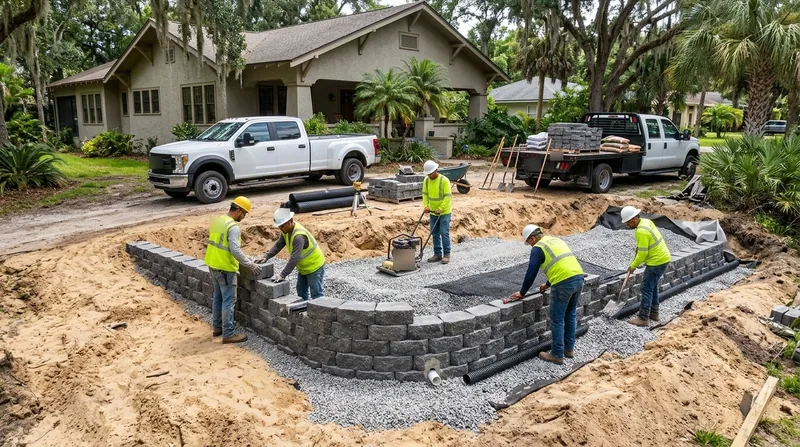




Block & Segmental Retaining Walls in Jacksonville are engineered solutions built from interlocking modular blocks, designed to hold back soil on sloped properties across our region's flat, sandy coastal plain. Jacksonville's terrain, carved by the St. Johns River, tidal creeks, and countless retention ponds, creates constant pressure on property boundaries, especially in neighborhoods like Riverside, Avondale, San Marco, and the newer Nocatee subdivisions. Fine sand washes through joints, high water tables saturate foundations, and tropical storm downpours destabilize aging timber and stucco walls. Segmental block walls, reinforced with geogrid and properly drained, stop these failures before they collapse into driveways, pools, or neighboring properties. We install, repair, and replace block walls using proven systems like Allan Block, Versa-Lok, and Keystone, tailored to Jacksonville's moisture and soil conditions. Call us at (904) 490-7307 for a free estimate, or read about our broader retaining wall installation services.
Why Block & Segmental Retaining Walls Matter in Jacksonville's Waterfront and Upland Neighborhoods
Jacksonville's historic neighborhoods along riverbanks and creek ravines, from Fishweir Creek in Riverside to Big Fishweir in Ortega, sit on low bluffs and sandy slopes that erode and slump without proper retention. Modern subdivisions in Oakleaf Plantation, Nocatee, and Fleming Island are built on raised fill pads that settle and destabilize over time. Segmental block walls are mortarless, modular systems that flex slightly with ground movement, unlike rigid poured concrete or aging stucco CMU walls. They shed water through engineered drainage, prevent sand from washing out through joints, and allow you to build curves, terraces, and multi-tiered gardens without extensive formwork.
- We size and place geogrid reinforcement layers to distribute load across the entire wall height and depth, preventing punch-through failure in Jacksonville's soft, saturated sand.
- We install perforated drain pipe and filter fabric behind the block face to channel groundwater away from the wall, stopping hydrostatic pressure from pushing it forward.
- We set proper footing depth and compacted base, accounting for seasonal water table fluctuations and the fine sand that dominates Jacksonville's subsurface.
- We align the wall face to slope slightly back (batter), which improves stability and sheds surface water away from the block joints.
These details prevent the slow creep and sudden collapse that plague older timber walls and poorly drained concrete structures throughout Jacksonville.
Local example: A homeowner in San Marco noticed water seeping through an old stucco CMU wall during summer rains. The wall was leaning inward by 2 inches and cracking at the top. We replaced it with a 4-foot Versa-Lok segmental wall, installed proper drainage, and added a slight batter. The new wall has held solid through two hurricane seasons.
For more details on wall repair and replacement, visit our retaining wall repair page.
How We Install Block & Segmental Retaining Walls in Jacksonville: Step-by-Step Process
Every segmental wall job starts with a site walk to measure slope, check soil composition, and identify groundwater or drainage issues. Jacksonville's sandy soil and high water table mean we always plan for drainage first, then build the wall structure. We handle permitting with the local building department (walls over roughly 4 feet or supporting a surcharge like a driveway typically require a permit), and we confirm setback and property-line requirements before we break ground.
- We excavate and compact a level base trench, removing soft or organic material and setting the footing depth below the seasonal high water table.
- We lay the first course of block level and straight, using a laser level to ensure proper alignment and batter (backward slope).
- We install geogrid reinforcement on top of the first course, extending it back into the retained soil at the specified spacing and length.
- We lay the second course of block, staggering the joints, and repeat the geogrid layer every two to three courses depending on wall height and soil load.
- We run perforated drain pipe along the back of the wall at the footing level, wrapped in filter fabric, and route it to daylight or a drainage swale.
- We backfill behind the wall with compacted drainage rock and soil, sloping the top surface away from the wall to shed surface water.
- We cap the top course with finished block or a decorative cap stone, and grade the area to prevent ponding.
The entire process typically takes 3 to 7 days for a standard wall, depending on height, length, and site access.
Jacksonville example: A homeowner in Orange Park wanted to build a raised pool terrace on a sloped lot. We installed a 3-foot tiered Allan Block wall with curves to match the pool deck. The geogrid and drainage system handle the seasonal water table rise in spring, and the slight batter keeps the wall stable under the weight of the pool equipment and deck traffic.
Learn more about our retaining wall drainage solutions to protect your investment.
Block & Segmental Retaining Wall Methods and Materials
| Approach | Description | Best for |
|---|---|---|
| Allan Block Segmental Wall | Mortarless interlocking concrete blocks with a distinctive architectural face and built-in lip for geogrid placement. Durable, low-maintenance, and widely available in Jacksonville. | Residential walls up to 6 feet, raised beds, pool terraces, and visible garden applications where aesthetics matter. |
| Versa-Lok Segmental Wall | Modular block with a smooth or split-face finish, stackable without mortar, and engineered for high lateral loads. Excellent drainage performance in sandy soil. | Taller walls, slopes with heavy water infiltration, and properties where water table control is critical. |
| Keystone Segmental Wall | Lightweight, hollow-core blocks with integrated geogrid pockets and a curved design that resists tipping. Quick installation and easy customization for curves and bends. | Curved walls, tiered designs, and properties where installation speed and design flexibility are priorities. |
| Geogrid Reinforced Segmental Wall | Any segmental block system enhanced with engineered geogrid layers spaced every 18 to 24 inches, extending 6 to 12 feet back into retained soil. Critical in Jacksonville's sandy substrate. | All walls over 4 feet, slopes with poor soil bearing capacity, and properties subject to surcharge loads like driveways or structures. |
Block & Segmental Retaining Walls Cost in Jacksonville: What to Expect
Segmental block walls in Jacksonville start at $25 per square foot for a straightforward installation on stable, well-drained soil with good site access. A 50-foot wall standing 4 feet tall typically costs between $5,000 and $7,500 before permitting or site preparation. However, several factors push that number higher. Sandy soil with a high water table requires deeper footings and more robust drainage, adding 15 to 25 percent to the base cost. Tiered or curved walls take longer to lay and need additional block and geogrid, raising the per-square-foot rate to $30 to $40. Tight site access, nearby structures, or protected trees can double labor costs. Jacksonville's permitting process, while straightforward, typically adds 100 to 300 dollars and 1 to 2 weeks to the timeline.
We always recommend getting two or three estimates before committing, and always ask what is included at the quoted price. Some contractors bundle drainage and backfill; others charge separately. We include drainage material, geogrid, proper compaction, and grading in our pricing, so there are no surprise add-ons. Visit our pricing page for a detailed breakdown of what drives costs up or down on your specific property.
Block & Segmental Retaining Walls Near Me: What Jacksonville Homeowners Should Know Before Hiring
Choosing a retaining wall contractor is not just about price. Jacksonville's unique soil, water table, and seasonal weather demand expertise in local conditions and strict adherence to building codes. Before you sign a contract, verify that the contractor is licensed and insured for the work in your jurisdiction. Florida requires a general contractor license (if the wall is part of a larger project) or a specialty license for retaining wall installation; confirm this with the Florida Department of Business and Professional Regulation. Ask for proof of liability and workers' compensation insurance, and request references from recent jobs in your neighborhood or similar terrain.
Get multiple estimates and ask each contractor to explain their drainage strategy, geogrid placement, and footing depth. If your wall is taller than 4 feet or will support a driveway or structure, confirm that the contractor will pull a permit and work with the local building department. Some Jacksonville neighborhoods and homeowner associations have setback or design approval requirements; verify these before work starts. The cheapest estimate is rarely the best choice if it skips proper drainage or geogrid in our sandy, saturated soil. Contact us at (904) 490-7307 or visit our contact page to request a free, no-obligation estimate and discuss your specific site conditions.
Block & Segmental Retaining Walls in Jacksonville: Pricing Guide
| Service | Price | Details |
|---|---|---|
| Standard Segmental Block Wall | Starting at $25/sq ft | Includes block, geogrid, footing, drainage, and backfill on stable soil with good access and no surcharge load |
| High Water Table or Tiered Wall | Starting at $30-$40/sq ft | Accounts for deeper footing, extended drainage, additional geogrid layers, and curves or multiple tiers in Jacksonville sand |
| Tall or Engineered Wall | On estimate | Walls over 6 feet or supporting driveways require site-specific design, soil testing, and engineered drawings from a professional engineer |
| Permitting and Engineering | $100-$300 plus design fees | Local building department review and potential engineered drawings for walls over 4 feet or with structural surcharge requirements |
| Travel | Included | No separate mileage or call-out fee within Jacksonville and surrounding service areas |
| Free Estimate | No cost, no obligation | Site walk, measurements, and written quote within 24 hours, call (904) 490-7307 to schedule |
Indicative pricing, the exact cost depends on square footage, finish, and site access. Free personalized estimate within 24h at (904) 490-7307.


