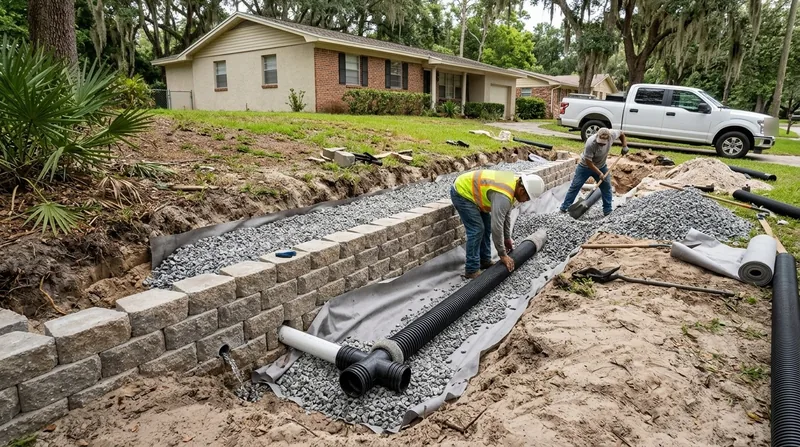




Jacksonville's retaining walls face a unique challenge: water. Built on a flat, sandy coastal plain cut by the St. Johns River and countless retention ponds, most homes in Riverside, Avondale, San Marco, and the newer subdivisions of Oakleaf and Nocatee sit on raised fill or near high water tables. When retaining wall drainage fails, fine sand washes out through joints, hydrostatic pressure builds behind the wall, and what looked solid six months ago starts to lean or crack. French drains, weep holes, and filter fabric are not optional upgrades in Jacksonville, they are the foundation of a wall that lasts. We install and repair drainage systems that relieve pressure, keep sand in place, and stop the most common failure mode in this region before it starts.
Why Retaining Wall Drainage Fails in Jacksonville's Sandy, Wet Terrain
Jacksonville drains poorly by nature. The sandy soil that makes up most of the coastal plain holds water like a sponge, and the high water table means hydrostatic pressure builds quickly behind any wall, especially after tropical storms and hurricane downpours. Block walls, poured concrete, and aging timber walls all fail the same way: water saturates the backfill, pressure pushes the wall forward, and the sand migrates out through joints and weep holes that were never installed or have clogged over time. In neighborhoods like Mandarin, Jacksonville Beach, and Atlantic Beach, we see leaning walls and collapsed sections every season.
- Hydrostatic pressure from a high water table and poor drainage pushes walls forward and causes them to lean or crack.
- Fine sand washes out through mortar joints and behind filter fabric when drainage systems are missing or inadequate.
- Weep holes that are clogged or never installed allow water to pool behind the wall instead of draining freely.
- French drains that are undersized or installed without proper stone backfill and filter fabric fail to relieve pressure before failure occurs.
- Tropical storms and hurricane-season rainfall overwhelm walls without proper subsurface drainage, leading to emergency repair or full replacement.
A properly designed drainage system catches water before it becomes a problem, directing it safely away from the wall and keeping sand where it belongs.
Key info: In Orange Park and Fleming Island, we regularly find 15 to 20-year-old block walls with zero drainage. Once we install a French drain, clean stone backfill, and filter fabric, those walls stop moving immediately. The fix is not expensive compared to a full replacement, which can run $8,000 to $15,000 or more.
For more on how walls fail and what repair options are available, see our retaining wall repair page.
How We Install and Repair Retaining Wall Drainage in Jacksonville
Drainage retrofit and new-wall installation follow the same principle: remove or prevent water buildup behind the wall. On existing walls, we expose the back face, install or replace a French drain at the base, lay clean stone backfill, and add or replace filter fabric to prevent sand from clogging the stone. On new walls, we build drainage into the system from the start. Every job begins with a site assessment to understand the water table, soil conditions, and how water flows across the property.
- We assess the site, measure the water table depth, and identify how water moves through the soil around the wall.
- We expose the base of the wall or prepare the backfill area and install or replace a perforated drain pipe in gravel or stone.
- We lay clean stone backfill (typically 3/4-inch or 1-inch crushed stone) behind the wall to allow water to flow freely to the drain.
- We install filter fabric (geotextile) between the soil and stone to prevent fine sand from migrating into the stone and clogging the drain.
- We tie the drain to daylight, a sump pit, or a surface outlet where water can flow away from the wall and the property.
- We backfill above the stone with native soil and compact it to prevent settlement and water ponding.
On a typical residential wall in Jacksonville or Jacksonville Beach, this process takes one to three days depending on wall length and access.
Local example: A 40-foot block wall in San Marco was leaning 2 inches at the top. We installed a 4-inch perforated drain at the base, wrapped it with filter fabric, backfilled with clean stone, and tied the drain to a daylight outlet at the property line. Cost was $3,800. The wall stopped moving within a week, and the homeowner avoided a $12,000 replacement.
Learn more about block and segmental wall repair and drainage.
Retaining Wall Drainage Methods and Materials
| Approach | Description | Best for |
|---|---|---|
| French Drain with Filter Fabric | Perforated pipe laid in clean stone at the base of the wall, wrapped with geotextile to prevent sand clogging, and tied to daylight or a sump pit. | Most walls in Jacksonville, especially block, concrete, and timber walls with high water tables or poor existing drainage. |
| Weep Hole Installation or Cleaning | Drilling or unclogging 1-inch to 2-inch holes through the wall face at regular intervals (typically every 4 to 6 feet) to allow water to drain directly from behind the wall. | Supplementary drainage on block or concrete walls, or as a quick fix when a French drain is not feasible due to site constraints. |
| Clean Stone Backfill with Geotextile | Replacement of compacted soil behind the wall with 3/4-inch to 1-inch crushed stone and filter fabric, allowing water to flow freely and preventing sand migration. | Any wall retrofit or new installation where existing backfill is clay, silt, or fine sand that traps water or migrates into drainage systems. |
| Sump Pit and Pump System | Installation of a buried collection pit at the base of the wall where drainage converges, with a submersible pump to move water away from the wall and property during heavy rain or high water table events. | Properties with no daylight outlet, very high water tables, or where gravity drainage is not possible due to terrain. |
| Surface Swale or Grade Correction | Regrading the land behind and around the wall to direct surface water away from the wall, combined with subsurface drainage to handle groundwater. | Properties where water pools behind the wall due to poor grading, or where a combination of surface and subsurface solutions is required. |
Retaining Wall Drainage Cost in Jacksonville: What to Expect
Retaining wall drainage work in Jacksonville typically starts at $2,500 for a basic French drain installation on a short residential wall, and scales up based on wall length, site access, soil conditions, and whether a sump pit or pump system is required. A 40-foot wall with a standard French drain, filter fabric, and stone backfill usually runs between $3,500 and $5,500. Properties in Nocatee, Orange Park, or Fleming Island with difficult access or very high water tables may run higher because we need more labor and equipment to reach the wall and manage groundwater.
The biggest cost variables are: how long the wall is, whether we can tie the drain to daylight or need a sump pit and pump, how much soil and clogged material we need to remove and replace, and whether the wall is still stable enough to work on or needs temporary bracing. A leaning wall in Jacksonville Beach that requires shoring and a full drainage retrofit will cost more than a stable wall in Springfield that just needs a French drain added. This is why we always recommend getting a free estimate on site before committing to a price.
Visit our full pricing page for more detailed cost information and factors that affect your specific job.
Retaining Wall Drainage Near Me: What Jacksonville Homeowners Should Know When Hiring a Contractor
Not every contractor understands drainage, and fewer still understand Jacksonville's unique water and soil challenges. A contractor who skips the assessment, installs undersized pipe, or uses the wrong backfill material will leave you with a wall that fails again in a few years. When you are looking for a retaining wall drainage contractor near Jacksonville, verify that they are licensed and insured, ask for references from recent drainage jobs, and make sure they understand local permitting requirements.
Many walls above 4 feet measured from the footing require a permit from the local building department, and engineered drawings may be required for tall or tiered walls. Always verify setback and property-line rules with your city or county before work begins. If your wall is in an HOA community like Oakleaf Plantation or Nocatee, check whether HOA approval is needed. A good contractor will walk you through these steps and help you avoid costly delays or code violations.
- Verify that the contractor holds a valid Florida contractor license and current liability and workers compensation insurance.
- Ask for at least three references from residential drainage or retaining wall repair jobs completed in the past 18 months.
- Request a written estimate that itemizes the scope, materials, timeline, and total cost, not a verbal quote.
- Confirm that the contractor understands local permitting requirements and will pull permits if needed for your wall height or design.
- Check whether your HOA or homeowners insurance has any restrictions on retaining wall work, and ask the contractor to coordinate with your insurer if required.
A contractor who takes time to assess your property, explain the drainage system, and answer your questions is worth the phone call.
Ready to get started? Contact us for a free estimate at (904) 490-7307. We serve Jacksonville, Jacksonville Beach, Atlantic Beach, Neptune Beach, Orange Park, Fleming Island, Fruit Cove, Nocatee, and surrounding areas.
Retaining Wall Drainage in Jacksonville: Pricing Guide
| Service | Price | Details |
|---|---|---|
| French Drain Installation (Residential Wall) | Starting at $2,500 | Perforated pipe, clean stone backfill, filter fabric, and daylight outlet for walls up to 30 feet long with standard access |
| French Drain with Sump Pit and Pump | Starting at $4,200 | Includes buried collection pit, submersible pump, and discharge line when daylight drainage is not possible or water table is very high |
| Weep Hole Installation or Cleaning | Starting at $1,200 | Drilling or unclogging existing holes through block or concrete wall face, typically 4 to 6 holes per wall as supplementary drainage |
| Full Drainage Retrofit with Soil Replacement | Starting at $3,800 | French drain, removal and replacement of compacted or clay backfill with clean stone, filter fabric installation, and grading correction |
| Emergency or Rush Drainage Repair | On estimate | Same-day or next-day assessment and temporary stabilization for leaning or actively failing walls; permanent drainage follows within one to two weeks |
| Travel and Estimate | Free | No charge for on-site assessment or written estimate; response within 24 hours across Jacksonville and surrounding service areas |
Indicative pricing, the exact cost depends on square footage, finish, and site access. Free personalized estimate within 24h at (904) 490-7307.


