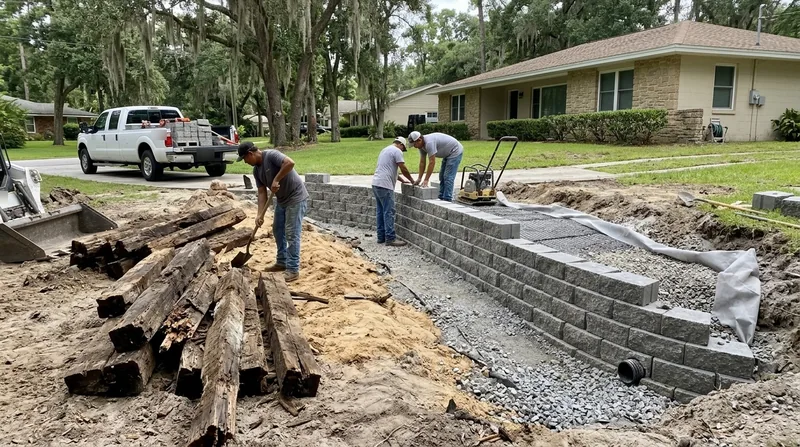




Railroad Tie Wall Replacement in Jacksonville is one of the most common retaining wall jobs we handle, especially across Riverside, Avondale, San Marco, and the older neighborhoods built on the sandy coastal plain that dominates this region. Thousands of Jacksonville homes built between the 1970s and 1990s still have landscape timber and creosote-treated railroad tie walls holding back their yards, and most of them are now failing. The combination of fine sand washing through joints, a high water table, tropical storm downpours, termite damage, and decades of UV exposure leaves these walls leaning, cracked, and unsafe. We remove the old ties, haul away the treated wood responsibly, rebuild proper drainage, and install a new wall in segmental block, poured concrete, or natural stone that will last another 40 years. This page covers why these walls fail, how we replace them, what you should expect to pay, and how to find the right contractor near you.
Why Railroad Tie Walls Fail in Jacksonville: The Real Culprits
Railroad tie and landscape timber walls were cheap to build and looked rustic, so they became the default choice for Jacksonville homeowners in the 1970s through 1990s. The problem is that Jacksonville's terrain and climate are hostile to wood. The sandy soil drains water straight through, and the high water table in areas near the St. Johns River, Fishweir Creek, and countless retention ponds means water pressure builds up behind the wall year-round. Tropical storms and hurricanes dump rainfall that saturates the backfill and pushes water through the wall joints. Termites, moisture, and UV light soften the creosote-treated ties from the inside out. By year 25 or 30, the wall is leaning, bulging, or collapsing.
- Fine sand washes out through gaps between ties, leaving voids and undermining the wall from behind.
- High water table and poor drainage cause hydrostatic pressure that pushes the wall outward and destabilizes the footing.
- Termites and rot eat through the wood, especially the buried portions that stay wet and warm year-round.
- Tropical storm and hurricane rain events overwhelm the backfill and force water through the wall faster than it can drain.
- Root growth from nearby live oaks and landscaping trees can crack ties or push sections out of plumb.
Understanding these failure modes is why we rebuild with proper drainage, compacted stone backfill, and a modern wall material that resists water and time.
Key info: In Riverside and Avondale, we often find 50-year-old railroad tie walls that have shifted 4 to 6 inches outward and cracked the brick or stucco on the house above them. The longer you wait, the more damage spreads to the foundation and landscaping. Call (904) 490-7307 for a free inspection if you see a leaning or cracked timber wall.
For more detail on the repair vs. replacement decision, see our page on retaining wall repair in Jacksonville.
How We Replace Railroad Tie Walls in Jacksonville: Our Process
Replacing a railroad tie wall is not a demolition job you hand to a general contractor. The old ties are heavy, the backfill is compacted sand that can cave in, and the new wall has to tie into the existing footing or sit on a new one if the ground has settled. We start with a site visit to assess the wall height, the footing depth, what's behind it, and whether permits are needed. Jacksonville and other local jurisdictions require a permit for walls taller than about 4 feet measured from the footing, or when the wall supports a driveway or structure. We handle all the paperwork and coordinate with the building department.
- We remove the old railroad ties and any failed landscape timbers, cutting them into manageable pieces and hauling everything away for proper disposal.
- We excavate and inspect the footing to see if it's sound or if we need to dig deeper and pour a new concrete base.
- We install a geotextile fabric and 4 to 6 inches of compacted stone backfill to create a drainage layer behind the new wall.
- We build the new wall in segmental block, poured concrete, or natural stone, depending on your preference and the site conditions.
- We backfill behind the wall with clean stone and topsoil, compact it in lifts, and grade the surface to shed water away from the wall.
- We install a perforated drain pipe at the base if needed to carry water safely away from the footing.
The entire job typically takes 3 to 7 days depending on wall length, height, and material choice. We work cleanly and haul away all debris daily so your yard stays accessible.
Example: A 40-foot-long, 3-foot-high railroad tie wall in Jacksonville Beach took 5 days to remove, regrade, and replace with segmental block. The old footing was sound, but we added 6 inches of stone backfill and a perforated drain to handle the high water table near the beach. Cost was $4,200. The new wall will last 40+ years with minimal maintenance.
If your wall also shows signs of leaning or collapse, read our guide to leaning and collapsed wall repair for urgent cases.
Railroad Tie Wall Replacement Methods and Materials
You have three main choices for what replaces your old timber wall. Each has different costs, lifespans, and looks. The right choice depends on your budget, the wall height, and whether you want a modern appearance or something that blends with older neighborhoods like Riverside or Avondale. Here is how they compare:
| Material | Description | Best for |
|---|---|---|
| Segmental Block | Interlocking concrete units that stack without mortar, allowing the wall to flex slightly and drain water through the joints. Available in many colors and finishes to match neighborhood aesthetics. | Most Jacksonville homes; affordable, durable, low maintenance, suits both modern and older neighborhoods. |
| Poured Concrete | A solid monolithic wall cast on-site or precast. Extremely strong and long-lasting, but requires careful drainage design because water cannot flow through the wall itself. | Tall walls (over 5 feet), high-load situations, or when a clean, modern look is desired. Requires a perforated drain pipe at the base. |
| Natural Stone or Boulder | Stacked coquina, granite, or large boulders set with or without mortar. Blends beautifully with mature Jacksonville landscapes and large oak trees. More labor-intensive and costly than block or concrete. | Historic neighborhoods, premium properties, or when you want a rustic, high-end appearance that complements Craftsman or Mediterranean Revival homes. |
| Timber (New) | Pressure-treated lumber or composite materials built with proper drainage and tie-backs. Not recommended as a full replacement for failed timber walls, but sometimes used for low walls (under 2 feet) in informal settings. | Rarely; most Jacksonville homeowners choose block or concrete to avoid repeating the failures of the 1970s-1990s timber walls. |
Each material choice affects your cost, timeline, and long-term maintenance. Segmental block is the most popular in Jacksonville because it balances cost, durability, and appearance.
Railroad Tie Wall Replacement Cost in Jacksonville: What to Expect
Railroad Tie Wall Replacement cost in Jacksonville starts at around $35 per square foot for a segmental block rebuild on a sound footing. A 40-foot wall that is 3 feet tall is 120 square feet, so that job would run roughly $4,200 to $5,000 depending on site access, soil conditions, and whether the old footing needs to be dug out and rebuilt. Poured concrete walls cost 15 to 25 percent more because of the formwork and curing time. Natural stone or boulder walls run 30 to 50 percent higher because of material cost and hand labor. The biggest cost drivers are wall length, height, footing condition, and how much old material has to be hauled away.
If the old footing is sound and level, your cost stays low. If we have to excavate, pour new concrete, or deal with unstable soil or high groundwater, the price goes up. Jacksonville's sandy terrain and high water table sometimes require deeper footings or additional drainage work, which adds cost. A wall near the St. Johns River or in a flood-prone area may need extra elevation or a robust drain system. Access also matters: if we can drive a truck close to the site, we save labor. If the wall is in a tight backyard with trees and tight fences, we work slower and charge accordingly.
The best way to know what your job will cost is to get two or three estimates from licensed contractors. We offer free estimates within 24 hours at our pricing page, and we can walk you through the factors that affect your specific wall. Call (904) 490-7307 or fill out a contact form to request a no-obligation site visit.
Railroad Tie Wall Replacement Near Me: What Jacksonville Homeowners Should Know When Hiring
Finding the right contractor for railroad tie wall replacement is not just about price. You want someone who understands Jacksonville's soil, water table, and building codes, and who will stand behind the work. Here are the key things to look for when you call contractors in Jacksonville, Jacksonville Beach, Orange Park, or any of our service areas. Licensed and insured status is non-negotiable: ask to see a current contractor license from the state of Florida and proof of general liability and workers compensation insurance. Get references from at least two recent jobs, and call them to ask if the wall is still standing straight, if drainage is working, and if the contractor cleaned up the site properly. Understand permits: if your wall is over 4 feet tall or supports a surcharge like a driveway, a permit is likely required. A good contractor will tell you this upfront and handle the paperwork. Some HOAs and historic districts have their own rules about wall materials and appearance, so ask your contractor if they are familiar with those requirements before you sign a contract.
- Verify that the contractor holds a current Florida general contractor license and can show proof of liability insurance and workers comp coverage.
- Ask for at least two references from similar jobs completed in the past 3 years and call them to ask about quality, drainage, and cleanup.
- Confirm whether your wall height and location require a permit from your local building department, and whether the contractor will obtain it.
- Check if your HOA or historic district (common in Riverside, Avondale, San Marco) has approval requirements for wall materials or appearance.
- Get a written estimate that includes the material type, wall dimensions, footing work, drainage plan, and a timeline for completion.
- Ask about warranty: a reputable contractor will guarantee the wall against defects in materials and workmanship for at least one year.
Taking time to hire the right contractor will save you money and headaches down the road. Contact us today for a free estimate and a straightforward conversation about your wall.
Railroad Tie Wall Replacement in Jacksonville: Pricing Guide
| Service | Price | Details |
|---|---|---|
| Segmental Block Replacement | Starting at $35/sq ft | Includes removal of old ties, new footing inspection or repair, geotextile and stone backfill, block installation, and compaction |
| Poured Concrete Wall | Starting at $42/sq ft | Formwork, concrete pour, curing, perforated drain installation, and backfill; best for tall walls or high-load situations |
| Natural Stone or Boulder Wall | Starting at $50/sq ft | Hand-stacked coquina, granite, or boulders; premium material and labor; suits historic neighborhoods and high-end properties |
| Footing Replacement or Soil Stabilization | On estimate | Required if old footing is failed, settled, or if high water table demands deeper excavation or geotechnical work |
| Travel and Estimate | Free | Included in Jacksonville service area; no mileage surcharge; response within 24 hours at (904) 490-7307 |
Indicative pricing, the exact cost depends on square footage, finish, and site access. Free personalized estimate within 24h at (904) 490-7307.


