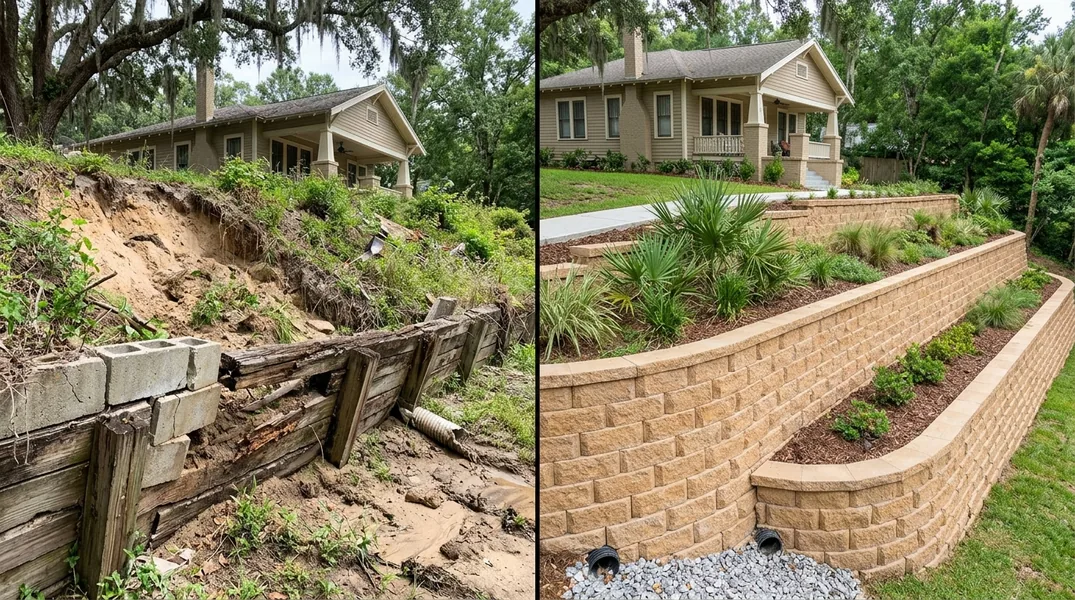
Why Jacksonville's Hurricane Season Threatens Your Retaining Wall
Every summer and fall, Jacksonville residents brace for hurricane season. While most homeowners focus on roof damage and flooding, many overlook a silent threat lurking in their yards: retaining wall failure caused by excessive rainfall and poor drainage. The combination of tropical downpours, saturated soil, and aging or improperly installed walls creates a perfect storm for structural collapse.
Retaining walls are designed to hold back soil and prevent erosion, but they depend entirely on proper drainage to function safely. When water accumulates behind a wall faster than it can drain away, hydrostatic pressure builds up inside the soil. This invisible force pushes against the wall with tremendous power, eventually overwhelming the structure's ability to resist. In Jacksonville, where the water table is already high and hurricane rains can dump several inches in hours, this scenario happens all too often.
If you've noticed cracks, bulging, or leaning in your retaining wall, the problem likely started months or even years earlier as water slowly compromised the structure. Understanding how drainage failures happen is the first step toward protecting your property and avoiding expensive Retaining Wall Replacement later.
Understanding Hydrostatic Pressure and Its Impact on Retaining Walls
Hydrostatic pressure is the force exerted by water pressing against a surface from all directions. In the context of retaining walls, it's the weight of saturated soil pushing horizontally against the back of the wall. A single cubic foot of water weighs about 62 pounds, and when you multiply that across the height and depth of a retaining wall, the total force becomes staggering. A wall that holds back soil just 8 feet tall can experience tens of thousands of pounds of pressure during heavy rain or flooding.
The problem intensifies in Jacksonville's climate. Our sandy, permeable soils drain quickly on the surface but hold water deep underground, especially near the water table. When hurricane rains fall, the soil behind a retaining wall becomes completely saturated within hours. If the wall lacks adequate drainage infrastructure, water has nowhere to go except to keep pushing against the structure. Over time, this constant pressure weakens the wall's foundation, cracks the concrete or masonry, and eventually causes catastrophic failure.
Many older retaining walls in Jacksonville were built without modern drainage considerations. They may have no drainage system at all, or only a simple gravel backfill that no longer functions properly. These walls are at highest risk during hurricane season, and homeowners often don't realize the danger until visible damage appears.
How Poor Retaining Wall Drainage Leads to Failure
Retaining wall drainage refers to the system of pipes, gravel, and perforated materials designed to collect water behind the wall and direct it safely away. Without proper Retaining Wall Installation that includes drainage planning, water accumulates in the soil and creates the hydrostatic pressure we discussed earlier. The most common drainage failure occurs when the original installation omitted a drainage system entirely, or when an existing system becomes clogged with sediment and roots over time.
A retaining wall french drain is one of the most effective solutions for managing water behind a wall. This system consists of a perforated pipe buried at the base of the wall, surrounded by gravel and filter fabric. Water percolates through the soil, enters the perforated pipe, and flows away from the wall to a safe discharge point. When installed correctly during the initial Retaining Wall Installation, a french drain prevents water buildup and eliminates most hydrostatic pressure problems.
However, many retaining walls in Jacksonville lack this essential feature. During normal weather, the wall may hold up fine. But when hurricane season arrives and torrential rains fall for hours or days, the wall suddenly faces forces it was never designed to handle. The result is often rapid deterioration: cracks form, the wall tilts outward, and in severe cases, a complete collapse can occur within weeks of the initial damage.
Signs Your Retaining Wall Is Suffering from Drainage Problems
Early detection of drainage problems can save you thousands of dollars in repair costs. Watch for these warning signs: visible cracks in the wall, especially horizontal cracks or those that widen over time; water seeping or pooling at the base of the wall; soil erosion behind or beside the wall; and any outward bulging or tilting of the structure. If you notice moisture on the interior side of the wall (if it's visible from a basement or crawlspace), water is definitely accumulating where it shouldn't.
Another red flag is vegetation growth at the base of the wall or soggy soil that stays wet long after rain stops. This indicates poor drainage and excessive moisture retention. During hurricane season, these conditions worsen dramatically. If your wall showed any of these signs before a major storm, the damage afterward could be severe.
The best approach is to have your wall inspected by professionals before hurricane season arrives. Jacksonville Retaining Wall offers comprehensive inspections to assess drainage conditions and recommend repairs before problems escalate. Catching issues early often means the difference between a simple repair and a complete Retaining Wall Replacement.
Solutions: Installing or Upgrading Retaining Wall Drainage Systems
If your retaining wall lacks proper drainage or the existing system has failed, several solutions are available. The most common approach is installing a french drain system along the base of the wall. This involves excavating along the wall's foundation, laying a perforated pipe in a bed of gravel, wrapping it with filter fabric to prevent sediment clogging, and backfilling with appropriate drainage material. The pipe directs water to a daylight outlet or to a dry well where it can safely percolate into the ground.
For Concrete Retaining Walls, additional solutions include installing weep holes (small openings that allow water to escape) and applying waterproof coatings to the wall's back surface. In some cases, improving surface drainage around the wall, such as grading soil away from the structure and installing gutters to direct roof runoff elsewhere, can significantly reduce water pressure.
The pricing for drainage improvements varies depending on the wall's length, height, and existing conditions. A simple french drain installation might cost several hundred dollars for a short wall, while more complex systems or extensive Retaining Wall Repair work could run several thousand. However, this investment is far less expensive than dealing with a collapsed wall or property damage from soil erosion. For a detailed assessment of your wall's drainage needs and a custom quote, contact Jacksonville Retaining Wall at (904) 490-7307 for a free estimate.
Preparing Your Retaining Wall for Hurricane Season in Jacksonville
As hurricane season approaches each year, homeowners should take proactive steps to protect their retaining walls. First, inspect the wall and surrounding area for signs of drainage problems or damage. Clear any debris, leaves, or sediment from the base of the wall and around any drainage outlets. If you have gutters or downspouts, ensure they direct water away from the wall and not toward it. Grade the soil around the wall so that water flows away naturally rather than pooling against the structure.
If your wall is older or you're unsure about its drainage system, now is the time to schedule a professional inspection. Jacksonville Retaining Wall can evaluate your wall's condition and drainage capabilities, then recommend improvements before the heavy rains arrive. Installing or upgrading drainage systems before hurricane season is far smarter than attempting emergency repairs after a storm has already caused damage.
For residents in Jacksonville Beach, Atlantic Beach, and surrounding areas, the stakes are particularly high due to proximity to the coast and typically higher water tables. Don't wait until you see visible damage. Reach out to Jacksonville Retaining Wall today at (904) 490-7307 to discuss your wall's drainage and get peace of mind before the next major storm.
Looking for a professional retaining wall contractor in Jacksonville? Jacksonville Retaining Wall responds fast for all your retaining wall needs.
Get a Free QuoteOur services: Retaining Wall Installation · Retaining Wall Repair · Retaining Wall Replacement