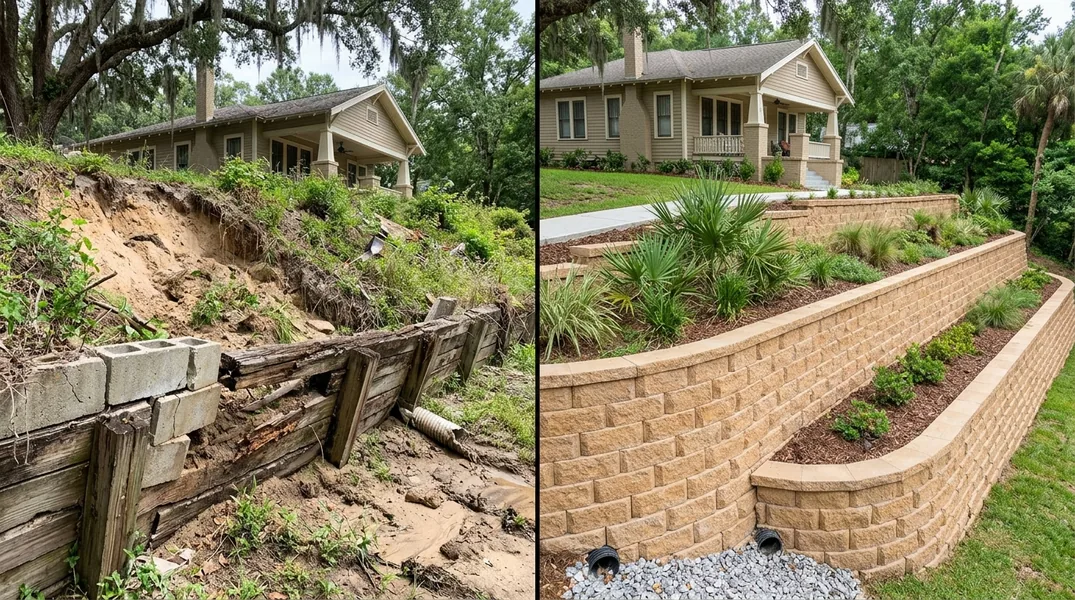
Understanding Jacksonville's Unique Soil Challenges
Jacksonville's geography presents one of the most challenging environments for retaining wall longevity in Florida. The region sits atop predominantly sandy, loose soil that lacks the structural stability found in clay-based or compacted earth. This sandy composition, combined with the area's high water table and frequent heavy rainfall, creates a perfect storm for retaining wall failure. Unlike more stable soil types, sand particles don't bind together effectively, meaning water infiltration causes the soil to shift, settle, and lose bearing capacity over time.
When homeowners invest in Retaining Wall Installation, many don't realize that the soil behind and beneath their wall is constantly working against the structure. In Jacksonville Beach and surrounding areas, this problem is even more pronounced due to proximity to the Atlantic Ocean and the influence of salt water on soil chemistry. The sandy substrate simply cannot provide the lateral support that a retaining wall needs to maintain its integrity over decades. This is why understanding your soil type before construction is critical, and why professional assessment matters so much.
How Water Infiltration Causes Retaining Wall Failure
Water is the silent enemy of retaining walls, especially in sandy soil environments. When rainfall or irrigation water saturates the soil behind a retaining wall, it adds significant hydrostatic pressure to the structure. Sandy soil drains quickly on the surface, but water can pool at deeper levels, creating pockets of saturation that exert constant pressure against the wall. Over months and years, this pressure gradually pushes the wall outward, causing it to bow, lean, or crack. Without proper drainage systems in place, even a well-constructed wall will eventually succumb to water damage.
The problem is compounded in Atlantic Beach and other low-lying areas where the water table is naturally high. During heavy rainstorms or seasonal flooding, the water table can rise dramatically, putting immense pressure on retaining walls. Additionally, if the soil behind the wall contains clay layers or compacted material, water cannot permeate freely and instead builds up, creating dangerous hydrostatic forces. This is why proper drainage infrastructure, including perforated drain pipes and gravel backfill, is absolutely essential during initial Retaining Wall Installation. Without it, you're essentially guaranteeing future problems.
Warning Signs Your Retaining Wall Is Failing
Spotting the early signs of retaining wall failure can save you thousands of dollars in emergency repairs or complete reconstruction. One of the most obvious warning signs is a leaning retaining wall, where the structure visibly tilts away from vertical. This tilt indicates that soil pressure has overcome the wall's resistance, and the problem will only worsen without intervention. Another critical indicator is horizontal cracking, which often appears in patterns across the face of the wall. These cracks suggest that the wall is being pushed outward and is beginning to fail under stress.
A bowing retaining wall is another serious red flag that demands immediate attention. Bowing occurs when the middle section of the wall bulges outward, creating a curved appearance rather than a straight line. This deformation means the wall is actively failing and could collapse without warning. You should also watch for water seepage or wet spots appearing on the face of the wall, which indicates poor drainage and soil saturation. Soil erosion at the base of the wall, cracks in nearby pavement or driveways, or the appearance of new vegetation growth in unexpected places can all signal underlying retaining wall problems. If you notice any of these warning signs, contact a professional immediately for evaluation.
Concrete Retaining Walls in Jacksonville: Durability and Maintenance
Concrete Retaining Walls are popular in Jacksonville because concrete is durable and can withstand the region's weather conditions better than wood or other materials. However, even concrete is vulnerable to failure when sandy soil conditions and water infiltration are not properly managed during installation. Concrete walls can develop cracks, spalling, and surface deterioration over time, particularly if the underlying soil is shifting or if drainage is inadequate. The key to extending the life of a concrete retaining wall is proper maintenance and addressing small problems before they become catastrophic.
Regular inspection of your concrete retaining wall should include checking for new cracks, monitoring for any signs of movement or lean, and ensuring that drainage systems are functioning properly. If vegetation is growing excessively behind or in front of the wall, roots can penetrate concrete and accelerate deterioration. In Jacksonville's humid climate, algae and mold growth on the wall's surface is common and should be cleaned periodically. If you notice any of the warning signs mentioned earlier, professional Retaining Wall Repair should be considered rather than waiting for the problem to escalate.
When to Consider Retaining Wall Repair or Replacement Near Me
Deciding whether your failing retaining wall can be repaired or needs complete replacement depends on several factors, including the extent of the damage, the age of the structure, and the underlying soil conditions. Minor cracks, small areas of spalling, or minor leaning might be addressed through targeted repairs. A professional inspection can determine whether reinforcement, improved drainage, or partial reconstruction will solve the problem. However, if your wall is severely bowed, actively leaning, or showing signs of imminent collapse, Retaining Wall Replacement may be the safer and more cost-effective long-term solution.
The best way to determine your options is to have a qualified contractor assess the situation in person. Jacksonville Retaining Wall offers free professional evaluations to help homeowners understand their options and make informed decisions. During an inspection, we'll examine the wall's structural integrity, soil conditions, drainage systems, and the root causes of any failure. This assessment allows us to recommend the most appropriate solution, whether that's repair, reinforcement, or replacement. If you're concerned about a retaining wall on your property, don't delay. Call Jacksonville Retaining Wall at (904) 490-7307 or request a free estimate today to learn about your options.
Prevention: Building Retaining Walls That Last in Jacksonville's Climate
The best way to avoid retaining wall failure is to invest in proper installation from the start. This means selecting a contractor who understands Jacksonville's unique soil and climate challenges and who prioritizes drainage, proper compaction, and appropriate materials. During initial Retaining Wall Installation, a quality contractor will install perforated drain pipes behind the wall, use gravel backfill to facilitate water drainage, and compact soil in layers to maximize stability. The wall should be built with a slight backward lean, called batter, which helps it resist outward pressure from soil and water.
Material selection also matters. While wood is less expensive upfront, concrete and engineered solutions offer superior longevity in Jacksonville's environment. Understanding the pricing for different installation methods helps homeowners make smart choices that balance initial cost with long-term durability. A wall that costs slightly more to install but lasts 30 years is ultimately far less expensive than a cheap installation that fails in 10 years and requires emergency repair or replacement. If you're planning a new retaining wall project or need to address an existing problem, Jacksonville Retaining Wall is here to help. Contact us at (904) 490-7307 or visit our website to discuss your project needs and get started on a solution that will protect your property for years to come.
Looking for a professional retaining wall contractor in Jacksonville? Jacksonville Retaining Wall responds fast for all your retaining wall needs.
Get a Free QuoteOur services: Retaining Wall Installation · Retaining Wall Repair · Retaining Wall Replacement